

Developed in the 1950s by renowned psychologist Albert Ellis, Rational Emotive Behaviour Therapy, REBT, focuses on challenging your ‘irrational’ beliefs and replacing them with more ‘rational’ ones. This can help you move towards better emotional health. REBT is a form of Cognitive Behaviour Therapy (CBT). It is a powerful approach that can help manage your thoughts, emotions and behaviours more effectively.
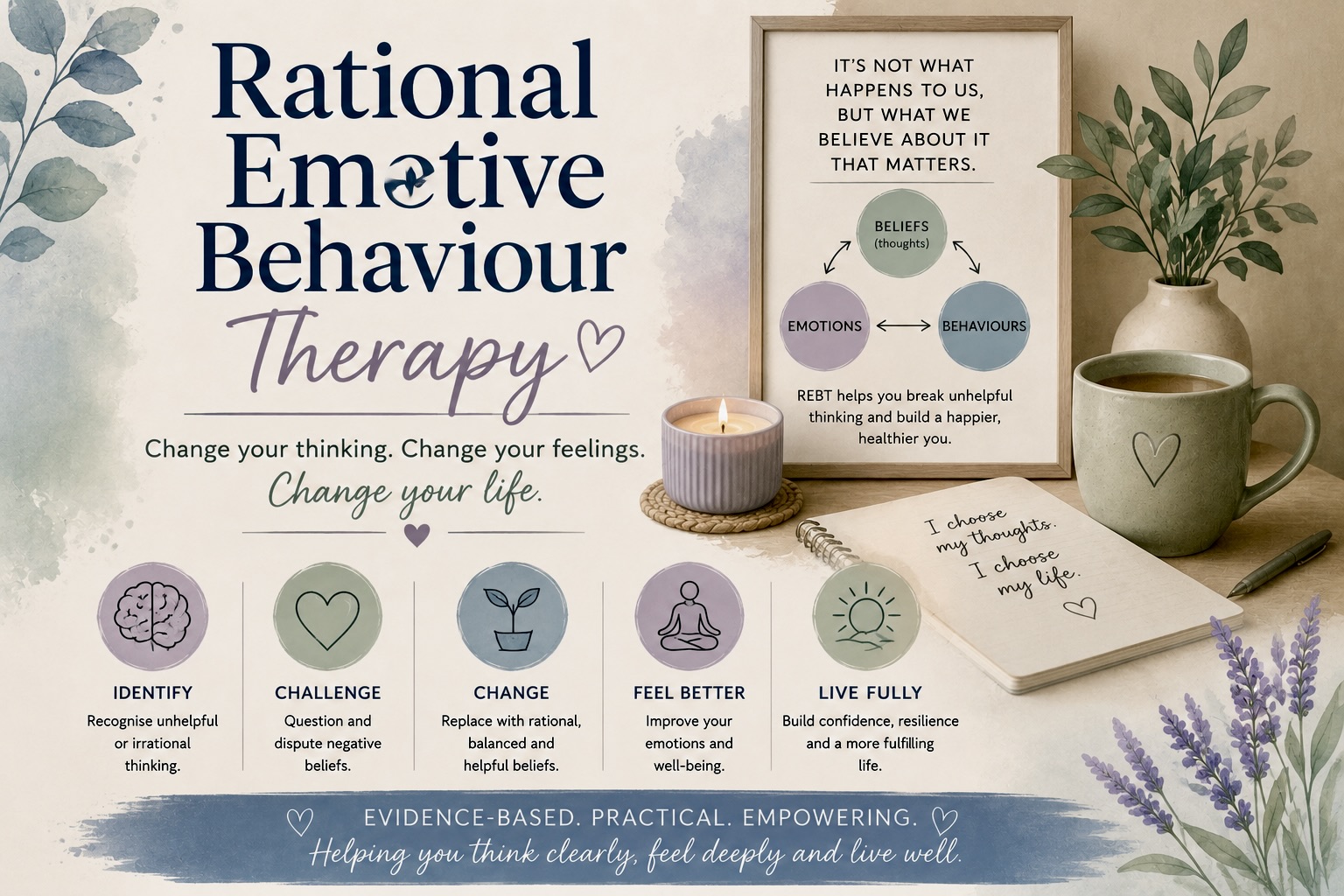
Although generally practiced during therapy, the principles of Rational Emotive Behaviour Therapy can be used in daily life to enhance your mental health and overall happiness.
So, let’s take a look at five basic, but practical, strategies using Rational Emotive Behaviour Therapy that you can use in day-to-day life.
Identifying and challenging your irrational beliefs
REBT emphasises the importance of identifying and challenging any irrational beliefs that are contributing towards negative emotions and behaviours. So start by paying attention to your self-talk and inner dialogue. If you catch yourself engaging with negative, self-defeating beliefs, stop and ask yourself if these are based on real evidence. Or are they actually just irrational and unfounded? Replace your irrational beliefs with rational, logical ones, that are more constructive and supportive.
For example, if you find yourself thinking, “I must be perfect in everything I do,” challenge this belief by reminding yourself that nobody is perfect and that mistakes are a natural part of growth and learning.
Practicing cognitive restructuring
Cognitive restructuring is a core technique used in Rational Emotive Behaviour Therapy to help modify your negative thinking patterns. Once you’ve identified your irrational beliefs, actively work on replacing them with more rational and helpful ones. Start by examining any evidence for and against your irrational beliefs. Consider alternative explanations, or perspectives, that are more realistic and more empowering.
For instance, if you catch yourself thinking, “I always fail at everything,” challenge this belief by reminding yourself of past successes and focusing on your strengths and abilities.
Using self-talk
Rational self-talk involves using positive and rational statements to counteract negative or irrational beliefs. When you notice self-defeating beliefs coming up, consciously replace them with affirmations or rational statements that reflect your reality more accurately. Repeat these statements to yourself regularly to reinforce your new more ‘positive’ thinking patterns.
For instance, if you find yourself thinking, “I’m worthless,” replace it with “I have value as a human being. My worth is not determined by my achievements, or lack of them.”
Getting to grips with emotional regulation
Rational Emotive Behaviour Therapy recognises there’s strong connection between your beliefs, emotions, and behaviours. To effectively manage your emotions, it’s crucial to pay attention to the beliefs you hold about yourself, or others, that trigger them. When you experience intense negative emotions, take a moment to identify the underlying irrational beliefs contributing to those emotions. Challenge those beliefs and replace them with rational thoughts that promote emotional well-being and resilience.
For example, if you feel overwhelmed by a setback at work and start catastrophising, remind yourself that setbacks are temporary and that you have the ability to overcome challenges.
Cultivating self-compassion
REBT emphasises the importance of self-acceptance and self-compassion. Treat yourself with kindness and understanding, especially when you’re facing difficulties or making mistakes. Acknowledge that it is perfectly normal to have imperfections and limitations. Instead of harshly criticising yourself, practice self-compassion by offering support, encouragement, and understanding.
For instance, if you make a mistake, instead of berating yourself with thoughts like, “I’m such an idiot,” remind yourself that everyone makes mistakes, and it’s an opportunity to grow and learn.
Strategies to help you challenge yourself
Adding these strategies to your daily life can be transformative. By challenging your irrational beliefs, restructuring your negative belief patterns, using rational self-talk, practicing emotional regulation, and cultivating self-compassion, you can enhance your emotional well-being and have a much calmer and more fulfilling life. But remember that change takes time and practice, so be patient with yourself as you put these strategies into place. Remember that with consistent effort and a commitment to self-reflection, you can gradually reframe your unhelpful beliefs and thinking patterns and develop a healthier mindset.
Get professional help if you need it
Obviously it’s important to note that while these strategies are really valuable for your own personal growth and emotional well-being, they are not a substitute for professional help. So if you’re dealing with severe or persistent mental health issues, please find a qualified therapist or psychologist who can provide additional support for you.
Remember that incorporating REBT into your daily life requires a conscious effort to become aware of your beliefs, emotions, and behaviours. So start by setting aside a few minutes each day for some self-reflection. Journalling can be a powerful tool for examining your beliefs and identifying patterns that may be holding you back.
As you become more familiar with your irrational beliefs, practice challenging them by asking yourself questions such as:
- Is this belief based on evidence or assumptions?
- Are there any alternative explanations or perspectives that are more rational and realistic?
- What would I say to a friend in a similar situation?
- Would I offer the same harsh judgments to them?
Remember, the goal is not to eliminate negative emotions, we can’t do that, but to develop a more balanced and rational outlook. Embrace the idea that setbacks, failures, and negative emotions are a normal part of life. By reframing them as opportunities for growth and learning, you can start building resilience and bouncing back when you need to.
Using positive affirmations
Incorporating positive affirmations and rational self-talk into your daily routine can help counteract negative thoughts. Think about creating a list of affirmations. But, here’s the important bit. They need to resonate with you. When you’ve found ones that work for you, that you do actually believe, recite them regularly. You can also write them on sticky notes and put them in visible places as reminders throughout your day.
Finding the connection
Practicing emotional regulation means recognising the connection between your thoughts, beliefs and emotions. If you’re finding yourself overwhelmed by negative emotions, step back and take a look at your underlying beliefs. Challenging those beliefs and replacing them with more rational ones will help set you up for better emotional well-being.
Don’t underestimate the value of self-care
Finally, cultivating self-compassion is vital in your journey towards applying REBT to your daily life. Treating yourself with kindness, empathy, and understanding is non-negotiable. Practicing self-care activities that cultivate your well-being, engaging in hobbies, spending time in nature, or connecting with loved ones are all important.
Rational Emotive Behaviour Therapy in a nutshell
Incorporating Rational Emotive Behaviour Therapy into your daily life can be transformative for emotional health and personal growth. By identifying and challenging irrational beliefs, restructuring negative thought patterns, practicing emotional regulation skills, and cultivating self-compassion, you can develop a more rational and resilient mindset. But remember, change takes time, so be patient and gentle with yourself as you navigate this process.

You must be logged in to post a comment.